




Connecticut Online Casinos Set October Record
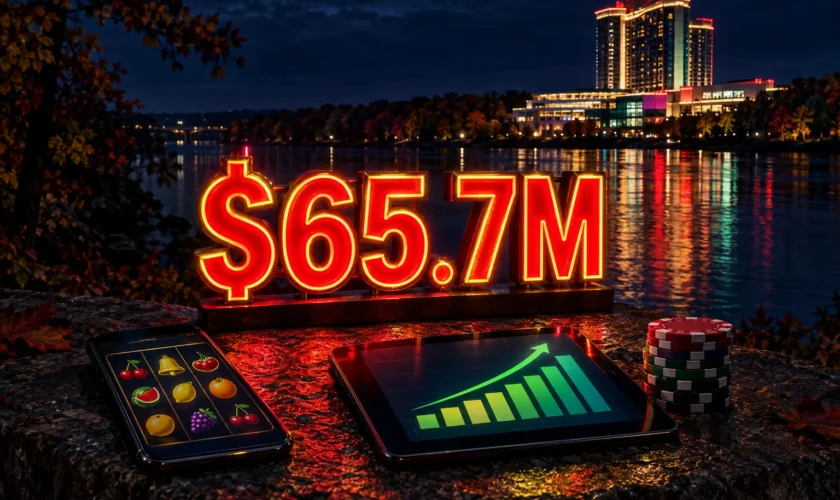
Online casinos in Connecticut brought in $65,749,691 in gross gaming revenue in October 2026, the biggest month since the games went live in 2021. The Department of Consumer Protection posts every licensee’s monthly return on the state’s open data portal, and October cleared the old high of $59,736,858, set in March 2026, by about $6 million.
It came in the first month the state took a bigger cut. October revenue was taxed at 20% instead of 18%, and Connecticut’s online casinos still paid the state $13,149,938 for the month.
A Record by a Clear Margin
October beat September’s $56,977,714 by $8,771,977, a 15.4% jump in a single month. Against October 2025, when revenue was $55,638,370, it was up 18.2%.
Players also bet more than they ever have. Wagers came to $2,057,059,458, the first month in the state’s records above $2 billion, and the previous high was September’s $1,953,567,020. Before promotions, online casino gaming win was $77,329,161. The operators then deducted $11,579,471 of promotional play to get down to the taxable figure.
The year is running well ahead, too. Revenue for January through October 2026 totals $570,499,333, up 14.8% on the $497,093,673 from the same ten months of 2025.
Bonus Play Ran Into the Cap
Connecticut limits how much promotional play an operator can knock off its taxable revenue. Since late 2023 the deduction is the lesser of the credits actually played or 15% of gaming win, and in October both licensees hit that ceiling.
MPI handed out $7,781,064 in promotional credits but could deduct only $5,818,120. Mohegan Digital gave away $8,935,635 and deducted $5,723,756. So more than $5 million of bonus play across the two was taxed as if it were revenue, which is one reason the state’s take keeps climbing even when the operators spend heavily on promotions.
DraftKings Edges Past FanDuel
Only the two tribes can hold a master wagering license for online casino games, and each runs its games through a big sportsbook brand. At launch the state named FanDuel as the Mohegan Tribe’s partner and DraftKings as the Mashantucket Pequot Tribe’s.
In October the Mashantucket license, MPI Master Wagering License CT, reported $32,969,344, against $32,434,616 for Mohegan Digital, the Mohegan licensee on FanDuel. The gap was just $534,728. A month earlier the order ran the other way and wasn’t close: Mohegan Digital had $30,476,694 to MPI’s $26,369,819.
The Small On-Reservation Games
Each tribe also runs a much smaller online casino on its own reservation. Those added $236,751 for the Mohegan Tribe and $108,980 for the Mashantucket Pequot Tribe in October, which is why the two big licensees don’t quite add up to the state total.
What the Two-Point Rise Is Worth
The rate change comes straight from the 2021 law. Under Section 12-866 of the Connecticut General Statutes, a licensee pays 18% of online casino revenue “during the five-year period after the first issuance of a license” and 20% from the sixth year on. Online casino gaming began on October 12, 2021, and the department’s own notes put the rate at 18% until September 2026 and 20% after that.
The math is simple enough. At the old rate, October would have paid the state about $11.8 million, so the higher rate added roughly $1.3 million on its own. The total payment of $13,149,938 was 31.3% more than the $10,014,906 collected in October 2025.
Online Casinos Dwarf the Sportsbooks
Connecticut’s online sportsbooks, which include the Connecticut Lottery’s alongside the two tribal licensees, posted $22,268,185 in gross gaming revenue in October on wagers of $261,381,366. Their tax payment was $3,061,875.
That is the same split showing up in the bigger states. Pennsylvania’s regulator called its October iGaming revenue the highest monthly total to date in the October online casino results for the big three markets, and iGaming keeps outgrowing sports betting across the regulated market.
In Connecticut, players bet about eight times as much on online casino games as on sports in October, and the casinos paid the state more than four times as much tax.
Written by
Nick Hall
Nick's passion for fast paced action has seen him test Bugattis for professional car reviews for the world's biggest car magazine, to covering the high octane world of online casinos, gambling regulation and emerging Web3 trends.


