




Pennsylvania’s Skill Games Become Illegal Slot Machines on Wednesday
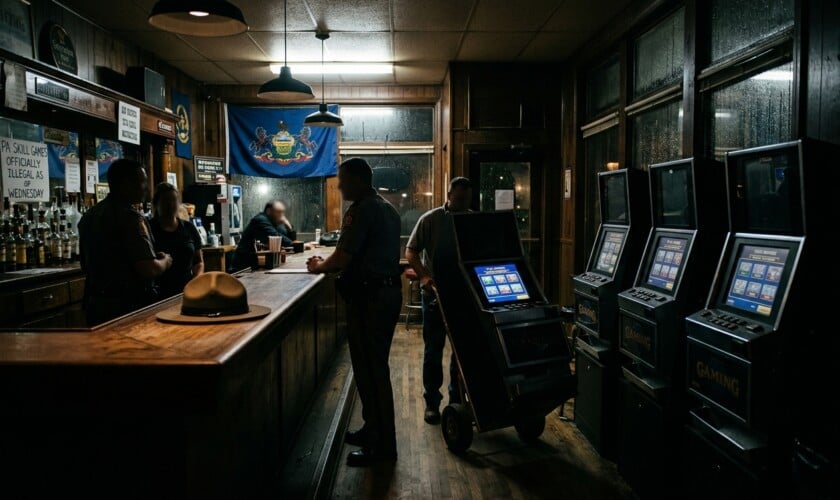
Pennsylvania bars, clubs and gas stations have until the end of Tuesday, October 13 to get their skill games out of the building. From Wednesday, October 14, the Pennsylvania State Police says every one of those devices outside a licensed venue is an unlawful slot machine open to “immediate seizure.” An estimated 70,000 machines are in play across the state.
The deadline comes from the state Supreme Court, which ruled on June 15 that skill games are slot machines under Pennsylvania gambling statutes and then stayed its own order for 120 days. On Friday, October 9, the court refused to extend that pause. Three lawmakers had asked for more time, through February 10.
Unplugging a Machine Won’t Save It
The State Police spelled out the terms in its October 5 advisory. “Powering off or unplugging an otherwise operable machine is not sufficient,” it says. A device “does not cease being a slot machine if it has simply been turned off, unplugged, or temporarily disabled,” and that covers pulling out hardware or software that can simply be put back.
The force’s skill games resource page lists what can follow. Officers can seize and forfeit the machines and their equipment, take the proceeds and file criminal charges. A bar or restaurant can also draw a citation against its liquor license, which may bring a fine or a suspension.
Section 5513 of the Crimes Code makes it a first-degree misdemeanor to set up, maintain, sell or lease a slot machine, and the advisory warns distributors and manufacturers that the same section applies to them.
The Machine Maker Reads It Differently
Attorney General Dave Sunday asked owners to act first in a September 29 statement: “We do not want to see searches and seizures at storefronts or bar, social club and restaurant establishments.” His office argued the case that produced the ruling, and it opposed the lawmakers’ request for an extension.
Pace-O-Matic, the skill games developer that was a party to one of the two cases, has given its customers a softer reading. A company spokesperson told Harrisburg station CBS 21 that “our understanding is that compliance requires the games to be rendered inoperable; it does not require the physical removal of the machines.”
That’s the opposite of what the State Police say. Businesses whose vendor won’t collect a machine are told to report the refusal to the force. In June, Pace-O-Matic said more than 10,000 small businesses and fraternal clubs would be “the real victims” of the decision, and added that it “will always abide by the rule of law.”
The Court Pointed at a 2017 Law
Justice David Wecht wrote the opinion, which decided two appeals together. One, No. 50 MAP 2024, grew out of a police seizure of three machines. The other, No. 2 EAP 2024, was Pace-O-Matic’s own suit against the Department of Revenue.
Two Commonwealth Court rulings had left the devices in a gray area of state gambling law, outside both the Gaming Act and the Crimes Code. Wecht called that reading “deeply flawed.” A 2017 amendment added “skill slot machine” and “hybrid slot machine” to the Gaming Act, which he said makes the skill element “not legally significant.”
He put the responsibility on Harrisburg. In the opinion’s words, “it is not this Court that declares ‘skill games’ to be unlawful. Rather, it is the General Assembly that did so nearly a decade ago.”
No Justice Called Them Legal
Chief Justice Todd and Justice McCaffery joined the opinion in full. Justices Mundy and Brobson joined it on the seizure appeal and, on narrower grounds, would have left the lower court’s order standing in the other. Justice Donohue concurred in the result, writing that the seized machines were gambling devices. Justice Dougherty did not take part.
The stay was the court’s concession to the people who had relied on the old rulings. For those 120 days, it wrote, “no law enforcement agency is to take adverse action against owners or operators.”
Harrisburg Ran Out the Clock
The stay was also a window for lawmakers, and they didn’t use it. Governor Josh Shapiro proposed a 52% tax on skill games’ gross terminal revenue in his budget, and the idea was left out of the budget he signed in July. Senate Republican leaders backed a 35% rate, other Republicans proposed 16%, and a newer House bill from Representative Russ Diamond sets it at 20%.
Senate Bill 1079, from Senators Gene Yaw and Anthony Williams, takes another route. It would charge $500 a month per terminal and cap the state at 50,000 machines, and its sponsors put the yield at $300 million a year. The Independent Fiscal Office has said taxing the games could eventually bring in more than $1 billion annually.
Licensed casinos have their own numbers. The Gaming Control Board lists a tax of 48%-54% on casino slot machines, and New Jersey law firm Saiber notes that casino license fees run as high as $50 million. Operators have long argued that skill games dodge both, a complaint that goes to how casinos make money in a state taking about half of every slot dollar.
Lawmakers Return After the Deadline
The General Assembly is due back in session on Monday, October 19, five days after enforcement starts.
In August, Pennsylvania’s casinos ran 24,520 slot machines, which made $213,901,476 and generated $108,082,835 in tax. The estimate for skill games is close to three times that number of machines.
Written by
Patrick Wiseman
Patrick is a seasoned iGaming writer and editor specializing in the evolving landscapes of sweepstakes casinos, social gaming, and real-money casinos. With an extensive portfolio ranging from technical casino reviews to industry news, Patrick translates complex gaming mechanics into accessible content for a global audience. Beyond his writing, Patrick brings a strategic edge to the editorial process. He has a proven track record of managing freelance teams, developing high-performing content briefs, and ensuring all output meets strict regulatory compliance and internal quality standards. His dual expertise in creative storytelling and technical oversight makes him a trusted voice in the digital gambling space.

Related News

Lawmakers Give FanDuel Until October 20 to Hand Over Its Celebrity VIP Videos

Patrick Wiseman
Casino Reviewer

Stake Lines Up a Legal Alberta Launch One Day Before the Gray-Market Cutoff
Patrick Wiseman
Casino Reviewer
