




Missouri AG Orders 6 Prediction Markets to Stop Sports Bets
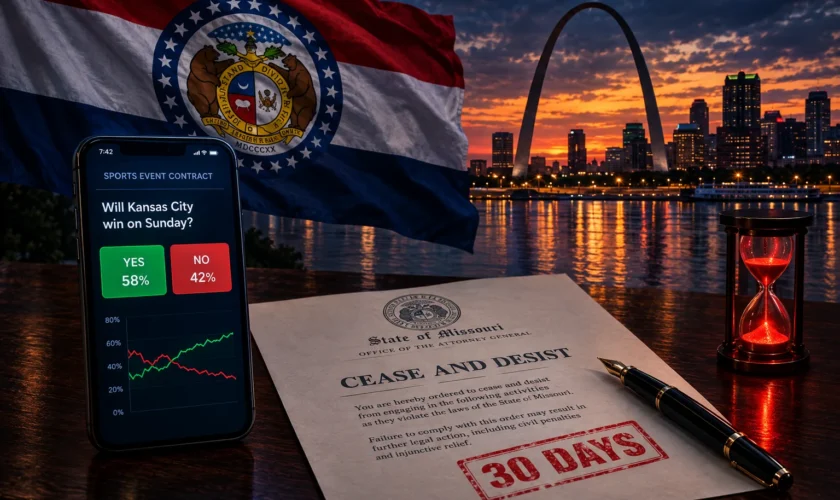
Missouri Attorney General Catherine Hanaway has sent cease-and-desist letters to six prediction markets, telling Kalshi, Polymarket, Crypto.com, Novig, Underdog and Robinhood that their sports “event contracts” are unlicensed sports wagering under Missouri law. Each letter asks the company to confirm within 30 days that it has either come into compliance or stopped offering sports wagering to people in the state.
The letters are dated September 16 and 17, and Hanaway’s office announced them that week. “Companies cannot repackage sports bets as ‘event contracts’ to avoid Missouri law,” Hanaway said. “We will enforce the rules voters approved and protect consumers.”
Two Options, and Both Cost Money
The six letters are close to identical. Each one gives the company two choices: stop, or get a license from the Missouri Gaming Commission, pay the state’s taxes and fees, and stop taking bets from anyone under 21. Missouri charges a 10% tax on sports wagering revenue, and the letters say the initial license fee and the renewal every five years “could be as much as $500,000” each.
The money is a big part of the argument. The Kalshi letter says the company has made money from Missouri bettors, “Yet Kalshi has kept all of that money for itself.” Hanaway was blunter in an interview with KFVS12 in Cape Girardeau. “I think it siphons a lot of money from a lot of the other sports betting sites that have to pay tax in Missouri,” she said.
Missouri’s own market is young. Voters approved Amendment 2 in 2024, and legal sports betting launched on December 1, 2025, through licensed sportsbooks and retail locations. The state collected $11.8 million in taxes in the first eight months, according to Missouri Gaming Commission figures reported by KY3.
The Age Problem at the Center
The sharpest charge is about age. Missouri’s betting age is 21, and the letters quote a commission rule that puts an “affirmative duty” on every platform to “actively prevent the placement of a wager” by anyone younger. Five of the letters then point to the companies’ own terms. Kalshi’s Member Agreement lets in anyone at “the age of majority in [their] state of residence”, which in Missouri is 18, and Crypto.com’s exchange terms also set the floor at 18.
The Novig letter is the only one that doesn’t make the age claim, and the press release names just the other five on that point. Hanaway went further on air. “They don’t have any kind of age verification, so we are concerned that they have people playing that are not of age,” she told KFVS12. Keeping under-21s out is one of the most basic responsible gambling duties a licensed book carries in Missouri.
The Companies Aren’t Budging
Robinhood and Polymarket gave the answer the industry has given every state so far. Robinhood said in a statement to KY3 that its event contracts are “federally regulated by the CFTC and offered through Robinhood Derivatives, LLC, a CFTC-registered entity.” Polymarket said it “maintains that prediction markets are regulated by the Commodity Futures Trading Commission under a federal framework, not a patchwork of state rules.”
Hanaway isn’t expecting a quick surrender. She said her office has seen other states settle with prediction markets, and that Missouri will sue if it can’t get a settlement. “Chances are they may sue us once they get this cease-and-desist letter,” she said.
Missouri Picks Its Precedents
The letters say Missouri “shares the same view as the majority of federal courts,” and they list the rulings: the Ninth Circuit’s Nevada decision of August 28, a Sixth Circuit ruling of April 24, and district court losses for Kalshi in Iowa on September 8, Connecticut on August 10, Utah on August 4 and New York on July 13. They don’t mention the Third Circuit, which held in April that federal commodities law preempts New Jersey’s gambling rules. New Jersey’s petition asking the Supreme Court to settle that split was docketed on September 8.
A Queue of States Forming
Missouri isn’t working alone. The week before, Connecticut ordered nine prediction markets to stop sports contracts and sent nearly 30 subpoenas to payment firms, data suppliers and media outlets. Five of Missouri’s six targets were on that list. Kalshi wasn’t on it, since Connecticut had already sued Kalshi separately.
Underdog has already answered Connecticut in court, filing a federal lawsuit against the state’s officials on September 15. Hanaway’s prediction about Missouri may not take long to test.
The regulator, meanwhile, is waiting on the judges. “The MGC will await the outcome of several court cases at the federal and state levels to help determine action or inaction by the agency in the future,” commission spokesperson Elizabeth Hoffman told ABC17. She added that the commission believes prediction markets have an impact on sports wagering revenue, “however, because they are not regulated, we have no idea what level that would be.”
Written by
Nick Hall
Nick's passion for fast paced action has seen him test Bugattis for professional car reviews for the world's biggest car magazine, to covering the high octane world of online casinos, gambling regulation and emerging Web3 trends.

Related News

L&L Europe Agrees £900,000 Settlement Over Unfair Withdrawal Terms

Patrick Wiseman
Casino Reviewer

Canadian Tourist Convicted Over Peachy the Flamingo, Faces 4.5 Years
Patrick Wiseman
Casino Reviewer

BetMGM Unveils LegendSCARY Halloween Casino Campaign
Patrick Wiseman
Casino Reviewer